
Thyroid and Fertility (part 3 of 3)
This is a test.
Now we’ve talked about symptoms that may indicate your thyroid needs some support, labs to ask for to assess thyroid function, and some foundational ways to support your thyroid (read Part 1 and Part 2). Now it’s time to chat about the most common thyroid issue: hypothyroidism
What is hypothyroidism?
Hypothyroidism is a condition in which the thyroid gland is considered ‘underactive’, meaning it does not produce enough thyroid hormone for the body.
How common is hypothyroidism?
Hypothyroidism impact about 5% of the population with the estimated 5% going undiagnosed. Hypothyroidism is more common in women vs. men.
What causes hypothyroidism?
Worldwide, the most common cause is iodine deficiency. In the US, which is considered iodine sufficient (but many people still fall short), Hashimoto’s thyroiditis (an autoimmune condition in which the body attacks the thyroid) is the most common cause of thyroid failure and hypothyroidism.
What are the symptoms of hypothyroidism?
Nearly every cell in the body uses thyroid hormone so when there’s not enough, symptoms can show up across the board. They include:
- fatigue
- brain fog
- dry skin
- irregular cycles
- heavy periods
- infertility/pregnancy loss
- hair loss
- elevated blood lipids
- constantly feeling cold
- stubborn weight loss
- unintentional weight gain
- among many more
How is hypothyroidism diagnosed?
Hypothyroidism can be diagnosed by your physician via a blood test measuring thyroid hormone levels. The most common thyroid lab test measures TSH (thyroid-stimulating hormone) but that doesn’t give you a full picture of thyroid function. I recommend clients get a full thyroid panel (TSH, total and free T3, total and free T4, reverse T3, and thyroid antibodies). That’s the only way to truly assess the functioning of the thyroid as a whole. Hashimoto’s is typically diagnosed by the presence of thyroid antibodies (which is why it’s important to have those measured!)
When being “diagnosed” with hypothyroidism, it should be noted that there’s a scale or range of diagnosis. You could be diagnosed with overt hypothyroidism (usually when TSH is high and major thyroid hormones are low). Or you could also be diagnosed with subclinical hypothyroidism (one example being when TSH is high but other major thyroid hormones are normal).
How does hypothyroidism impact fertility?
Your menstrual cycle relies on thyroid hormone for a number of reasons so when there isn’t enough thyroid hormone available, interruptions in your cycle can occur. That includes: reduced or extended time between cycles, anovulatory cycles (when you don’t ovulate), and heavy periods, among other symptoms. It can lead to what’s called subfertility meaning you still have the physical ability to get pregnant but there are obstacles in the way.
With thyroid autoimmunity (for example Hashimoto’s thyroiditis), it can make it more difficult to get pregnant by reducing thyroid function when the ovaries require thyroid hormone to recruit and mature follicles to ovulate. Having the presence of thyroid antibodies can reduce the number of follicles and lead to low ovarian reserve.
How does hypothyroidism impact pregnancy?
If untreated, hypothyroidism can pose a number of risks during pregnancy including: developing gestational hypertension or preeclampsia, placenta abruption, miscarriage, preterm delivery, or stillbirth. If treated but not adequately, there’s a risk of intrauterine growth restriction (IUGR) and/or low birth weight, and delays in neurological development.
With subclinical hypothyroidism, there is an increased risk of miscarriage and preterm delivery.
How is hypothyroidism treated?
With overt hypothyroidism, a medication consisting of synthetic T4 most likely will be prescribed to help provide the body with sufficient amounts of thyroid hormone. Sometimes desiccated thyroid that contains T4 and T3 hormone can be prescribed. With subclinical hypothyroidism, it depends on a number of factors including if you’re positive for thyroid antibodies, how high are TSH levels, and how total and free T3 and T4 look. It’s usually on an individual basis and also dependent on your doctor’s philosophy of a) whether subclinical hypothyroidism is a thing and b) if they think it needs to be treated or not.
In both cases of overt and subclinical hypothyroidism, it’s also helpful to continue doing the foundational habits to support your thyroid (read about that in this blog post), as well as some additional supportive habits.
What else can I do to support my thyroid?
Here are some more advanced ways to support your thyroid:
- eating enough throughout the entire day
- eating adequate amounts of protein (including seafood multiple times per week!)
- reducing exposure to endocrine disruptors
- consuming thyroid supporting vitamins and minerals
- getting good quality and adequate amounts of sleep
- effectively managing stress
- supporting digestion and absorption
Your thyroid plays a significant role in your fertility and future pregnancies (issues can also arise during postpartum but that’s for another blog post!) It’s worth it to provide your thyroid with what it needs to function properly!
If you find yourself struggling to get pregnant and suspect it might be your thyroid, reach out for help and support! I’m accepting new clients and you can apply to work with me here.
Thyroid and fertility (part 2)
Okay, so now that we know your thyroid is essential to your cycle, trying to conceive, and sustaining a healthy pregnancy, (if you missed part 1 of this thyroid series, click here to go read it!) let’s chat about what it looks like when your thyroid isn’t functioning at its best.
Symptoms that suggest your thyroid may need some support
The following symptoms can clue you in that your thyroid needs some lovin’. They include:
- unexplained weight loss
- unexplained weight gain
- irregular cycles
- infertility
- pregnancy loss
- heavy periods
- low BBT (below 97.5)
- brain fog
- hair loss
- dry skin
- brittle nails
- cold extremities
- lack of quality sleep
- sleep interruptions
- anxiety
If you’re reading this list and checked off three or more of these symptoms, it may be time to get your thyroid levels checked. The best way to do that is via bloodwork.
What labs to ask for to check thyroid levels?
The most popular test for checking thyroid is TSH or thyroid-stimulating hormone. That’s the hormone that helps your brain communicate with your thyroid (telling it to make more or less thyroid hormone). But that’s only one aspect of thyroid health. And the range conventional doctors use to determine “normal function” is wider than it should be – meaning your thyroid could be sluggish but deemed “normal”.
You want to ask for a full thyroid panel, which will include: TSH, total and free T4 (a major thyroid hormone), total and free T3 (the active form of thyroid hormone), thyroid antibodies (TPO and anti-Tg), and reverse T3 (the inactive form of thyroid hormone). This will give you a much more robust picture of how your thyroid is functioning.
What are some (maybe unintentional) things that could be sabotaging your thyroid?
- undereating
- overexercising
- skipping sleep
- skipping breakfast
- skipping carbs
What are some foundational ways to support your thyroid?
Some of the best ways to support your thyroid help to prevent unnecessary stress to the body and provide the thyroid with everything it needs (i.e. minerals!) to produce adequate thyroid hormone. They include:
- eat breakfast
- drink caffeine with breakfast
- adequate mineral intake
- don’t skip eating carbohydrates
What if you’ve had labs done and everything came back “normal” but you still have symptoms?
Conventionally speaking, thyroid levels may be deemed “normal” based on the current ranges provided. I like to see client’s thyroid functioning optimally, so the ranges I use are more conservative (i.e. smaller, more ideal numbers). So, you can have “normal” thyroid hormones on a conventional level but they may not on an optimal level.
Also, lab results are not end all be all. If you have normal labs but you’re still having symptoms, how you feel still matters (aka it’s not all in your head!) You can have normal thyroid function but since practically the entire body uses thyroid hormone, your cells may be struggling to effectively use that thyroid hormone. That comes down to your body’s stress response – emotionally, physically, mentally, illness, trauma, you name it, etc.
Okay, so that’s me. What should I do next?
You’ll want to find the root cause of your stress (again could be coming from a number of different reasons) and then figuring out how to alleviate that stress. Figuring that out is so individual. I would recommend working with a practitioner who is familiar and comfortable with thyroid issues and who also focuses on a whole body approach. Diet and lifestyle are huge players here so it requires a deep dive into food habits and routines and stress analysis and ultimately stress management techniques.
Thyroid issues can be tricky. If you suspect your thyroid may be interrupting your ability to get pregnant or even preventing you from feeling your best after having babies, apply to work with me here.
Thyroid and Fertility 101 (part 1)
January is Thyroid Awareness Month.
But actually, it feels like that every month over here in my little corner of the internet because I so heavily emphasize getting it checked with nearly all of my clients.
It’s because the health of your thyroid plays a significant role in your ability to get pregnant and your ability to sustain a pregnancy.
Your thyroid is a butterfly-shaped gland located in front of your throat and releases thyroid hormones that serves various functions throughout the body.
Nearly every single cell uses thyroid hormone to help with metabolism (processing nutrients and energy). Your thyroid can also be described as the thermostat of the body due to its role in controlling your temp.
Your thyroid is involved in:
temperature regulation
heart rate
nutrient metabolism
brain function
menstrual cycles
growth and development (for you always and for your baby while pregnant)
…among many more roles!
I’ll be focusing on the roles your thyroid plays in menstrual cycles and pregnancy and what can happen when there are disruption in thyroid function.
But before we get into that, I’ll go over how the thyroid works (important to discuss how it works under normal circumstances so you better understand what’s going on when it’s not working properly).
How the thyroid works
Your brain and thyroid communicate via the HPT axis or hypothalamus-pituitary-thyroid axis). The hypothalamus released TRH (thyrotropin-releasing hormone) that stimulates the pituitary gland.
The pituitary gland then releases TSH (thyroid-stimulating hormone) that stimulates the thyroid to release T3 (20%) and T4 (80%) (and calcitonin but we’re skipping over that part). T3 is much more potent than T4 and is considered the active form of thyroid hormone.
T3 and T4 then travel throughout the body assisting cells in regulating their metabolism (among the many other roles listed above). Cells can also convert T4 to T3 or reverse T3 (the inactive form of thyroid hormone) depending on needs.
When concentrations of T3 and T4 in your bloodstream reach a certain level or threshold, they create a negative feedback loop to your brain. This shuts off the release of TRH, which then shuts down the release of TSH, decreasing the stimulation of your thyroid. Normal stimulation resumes again once T3 and T4 levels decrease.
This is a “picture perfect” version of how your thyroid (should) function. Of course, things don’t always work out that way!
Thyroid’s role in menstrual cycles
The thyroid’s role in menstrual cycles is complex…to say the least. I’ve tried to simplify it here but know this is surface level. It goes much deeper than this and there’s still so much we don’t know.
Thyroid hormone plays a role in how sex hormones are made, transported, and excreted. By sex hormones we’re talking major players like estradiol and testosterone.
Thyroid hormone also plays a role in controlling other hormones that indirectly influence your cycle. So, thyroid hormone can influence factors such as the length between periods (whether short or long or if your period shows up at all) to how light or heavy your period flow is.
Thyroid hormones also act directly on ovarian cells. One role is to help facilitate the recruitment and maturation of follicles (very important as those are the beginning stages of ovulation).
So, when there are disruptions in thyroid function, it can have several downstream impacts on your cycle, which can ultimately impair your fertility.
That’s where taking care of your thyroid is SO important when it comes to preconception health and at the core of what I look into with clients who are struggling to get pregnant.
Thyroid’s role in pregnancy
There is an increased demand for thyroid hormone during pregnancy.
In the early weeks of pregnancy (up to week 12), the fetus is dependent on your thyroid’s ability to provide it necessary hormones.
By week 12, the fetus is starting to make its own thyroid hormones but still not enough until about weeks 18-20 (meaning still heavily dependent on you).
Most importantly, the fetus needs thyroid hormone to have proper brain and nervous system development. (Remember above when I mentioned that every cell in the body uses thyroid hormone to function).
Your thyroid needs to be able to not only provide you enough hormone but the fetus, too (and have that amount of hormone be enough but not too much!
Bottom line: the function of your thyroid is crucial to sustaining a healthy pregnancy!
This month we’ll be getting into the ways to support your thyroid and what labs to ask for to assess function!
If you’re wanting support for your thyroid while TTC, apply to work with me here!
5 of the Most Common Nutrition Myths I Hear All Too Often
Being in the nutrition world for over 13 years now, there are some nutrition myths that don’t seem to be going away. The myths listed below are among the most common ones I have clients asking about. Hopefully, this clarifies some things for you, too!
1) Myth: All carbs are bad and should be avoided.
Fact: When talking about carbs, you want to focus on quality. Fruits and vegetables count as carbohydrates and those are among the healthiest foods you can eat! When choosing grains or starches, focus on whole sources such as quinoa, whole oats, brown rice, and 100% whole wheat (pastas and breads) as much as you can.
2) Myth: Fruit should be avoided because it has too much sugar.
Fact: Fruit does contain naturally occurring sugar but, being high in fiber and various vitamins and minerals, the benefits of eating fruit far outweigh the negatives. The water content of fruit also dilutes the concentration of sugar that is present. So, go ahead and eat those bananas!
3) Myth: Eating too much fat will make you fat.
Fact: Eating too much of anything can add to excessive calories and potential weight gain. Again, you want to think of fat in terms of quality. Healthy fats include those found in seafood, nuts, seeds, olives, and avocados. Saturated fat has been long-established as a fat we need to limit. More recent research is showing that it’s not as bad as we once thought making the occasional full fat dairy okay, too. When it comes to oils, olive oil is still the number one choice for low-to-medium temperature cooking and flavoring. Avocado oil is newer to the market but has a higher smoke point* so it can be used for higher temperature cooking.
(*smoke point: the temperature at which an oil starts to burn and smoke. If an oil is heated beyond its smoke point, the food can have a burnt flavor and also the benefits of the oils – fatty acids, phytochemicals – may be destroyed. Higher smoke point oils can withstand higher temperatures during the cooking process. Look for smoke points listed on the bottle.)
4) Myth: Everyone should eat gluten free even if they don’t have a sensitivity because it’s healthier.
Fact: The short answer is not true. Gluten is a protein that’s found in wheat, rye, barley, and sometimes oats and does not pose a threat to the majority of people. Those with Celiac disease have a gluten intolerance and should avoid the protein as that is the primary form of treatment for the condition. Sensitivities to gluten also exist – called Non-Celiac Gluten Sensitivity (NCGS). This could be for someone who got tested for Celiac disease, the tests came back negative, but the person still does not feel well when they eat gluten. If you feel better not eating gluten, then I say avoid it. If you fall into that category, just be sure that you’re consuming adequate fiber and B-vitamins to make up for avoiding foods that contain gluten.
5) Myth: To lose weight, you have to make drastic changes that aren’t sustainable.
Fact: It’s actually the complete opposite! My philosophy is working with a person to develop easy, sustainable lifestyle changes that specifically work for them. There’s no “one way” to lose weight. There are different ways that work for different people!
Have questions or other nutrition myths you’d like to discuss?
To find out more or if you’re interested in making an appointment, feel free to do so here!
Fresh Thanksgiving Sides
Thanksgiving is so soon! I can’t wait because Thanksgiving is my F-A-V-O-R-I-T-E holiday of all time. A day focused on family, love, gratefulness, traditions, football, and best of all, FOOD!
I usually spend the day before Thanksgiving cooking and prepping with my mom, decorating the table, and getting ready for a day full of deliciousness. We usually rely on easy, make-ahead side dishes to minimize the amount of work on the actual day.
Now, the only reason I eat turkey is for the sides – who’s with me?? Mashed potatoes, stuffing, and casseroles – YUM! But Thanksgiving is known for that full feeling that causes your Uncle Henry to fall asleep at the table and everyone to change into their sweatpants before dessert. So today, I’m sharing some delicious and dietitian approved Thanksgiving sides with a fresh twist – to fill you up (and not fill you with guilt).
Mashed Cauliflower
Mashed cauliflower made with vegetable stock provides an earthy taste with a similar texture to mashed potatoes (but a fraction of the calories). The recipe is straightforward and can be made the day before!
Ingredients
- 1 large head of cauliflower
- 3.5 cups of vegetable stock
- 1 tbsp. of olive oil
- Salt and pepper to taste
Directions
Chop the cauliflower into small florets. Sauté the florets with olive oil in a large pot or Dutch oven for 15 minutes. Add the vegetable stock and bring to a boil. Cook until cauliflower is fork tender (about 10 minutes). Save about ½ cup of the cooking liquid prior to draining. Drain and place the cauliflower back into the pot. Use an immersion blender to combine. Add cooking liquid to desired texture. Flavor with salt and pepper.
Roasted Brussels Sprouts & Chickpeas
Roasted vegetables are an easy, nutritious, make-ahead side dish. With Brussels sprouts being my favorite – I had to include them in this list!
Ingredients
- 1 lb of Brussels sprouts
- 2 cans of chickpeas
- 2 tbsp. olive oil
- 1 tsp. salt
- 1 tsp. pepper
- 1 tsp. garlic powder
Directions
Preheat the oven to 400°F. Chop the ends off of the sprouts and cut them into quarters. Drain and rinse the chickpeas, patting them dry between two kitchen towels. Place sprouts and chickpeas into a bowl and add the olive oil, salt, pepper, and garlic powder. Mix well and place on a sheet pan in a single layer. Roast for 25 minutes.
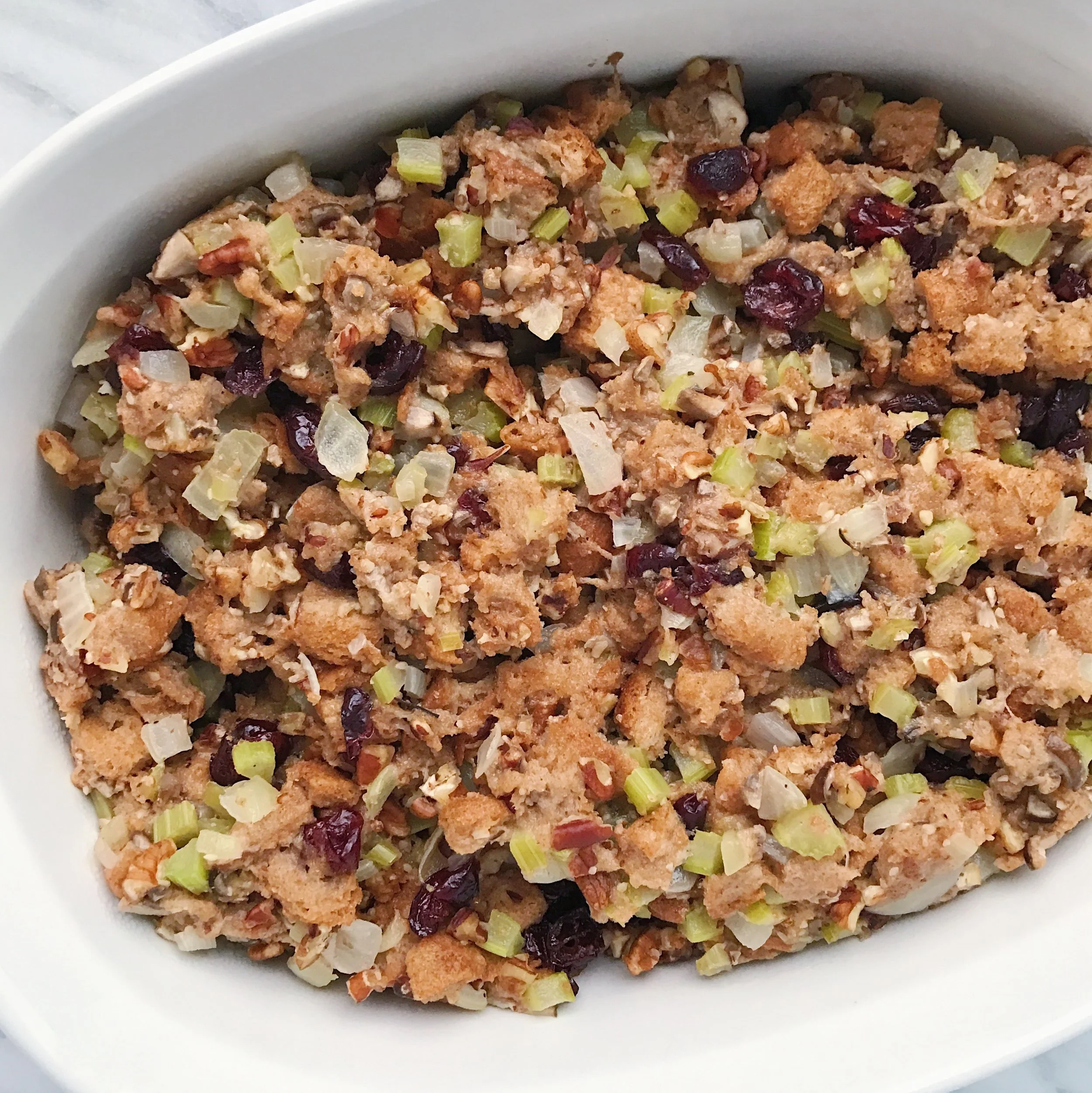
Whole Wheat Stuffing
This stuffing recipe tastes like the classic but a higher vegetable to bread ratio and swapping out the white bread for 100% whole wheat makes it a healthier alternative!
Ingredients
- 6 slices of good quality whole wheat bread
- 4 celery stalks, diced
- 1 large sweet onion, diced
- 3 cups mushrooms, diced
- 1 tbsp. olive oil
- 2 cups vegetable stock
- 1 cup chopped pecans
- ¾ c. dried cranberries
Seasoning
- 1 tbsp. poultry seasoning
- 2 tsp. salt
- 2 tsp. pepper
- 2 tsp. garlic powder
- 2 tsp. onion powder
- 1 tsp. rosemary
- 1 tsp. thyme
Directions
Preheat the oven to 350°F. Cut the slices of whole wheat bread into 1 cm cubes and place on a sheet pan in a single layer. Bake the cubes for 12 minutes to dry them out and set aside. Combine the seasoning in a small bowl and set aside. Sauté onions, celery, and mushrooms with olive oil in a large pot until softened. Add the vegetable stock and bring to a boil. Remove from heat. Add the cubed bread, pecans, dried cranberries, and 1.5 tbsp. of the seasoning (there will be extra). Mix well. Taste test and add more seasoning to your liking. Place in an oven safe dish and bake for 25 minutes until the top is golden brown and toasted.
Citrus Honey Cranberry Sauce
Cranberry sauce is known for being high in sugar. Honey adds more flavor (so less sugar is needed), which will cut the tartness of the cranberries but still provide that traditional taste.
Ingredients
- 6 oz. of cranberries
- 2 tbsp. sugar
- 2 tsp. good quality honey
- ¼ cup water
- ¼ cup fresh orange juice (juice from half an orange)
- Zest from 1 whole orange
Directions
Combine cranberries, water, zest, and orange juice. Bring to a boil and add the sugar and honey. Stir until well mixed and simmer until reduced (about 10 minutes).